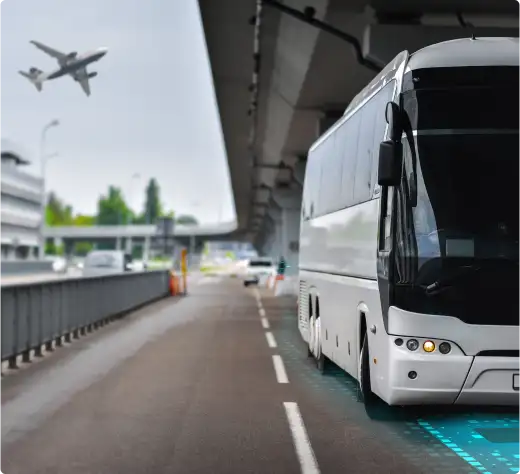
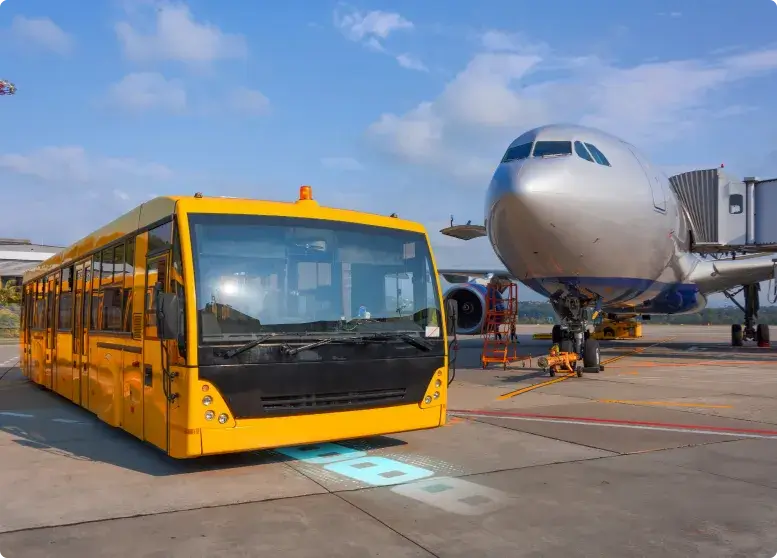
Electreon’s wireless charging keeps airport fleets powered up—while they wait and while they move. Shuttles and buses spend hours looping terminals or waiting for passengers. Electreon turns that built-in downtime into effortless, all-day power boosts. Forget charging breaks and bulky hardware—think lighter fleets and greater profits.
Optimize energy use with daytime charging—avoiding costly batteries, extra chargers, peak loads, and grid strain.
Charges multiple vehicles during downtime or overnight—weatherproof, energy-efficient, and space-smart.
Top up buses during slowdowns at terminals or apron areas—keeping them running without battery level worries.
Powers buses, GSE (ground support equipment) and service vehicles while driving on shared, charging lanes—eliminating charging stops.
TWO wireless DOT charging spaces power
round-the-clock
shuttle operations*
*Based on Electreon’s projects
Generate new revenue with Charging as a Service (CaaS), billing taxis in stop-and-go queues, private and shared cars, hotel shuttles and public buses while waiting.
Reduced battery size, reduced TCO, more room for luggage
Keep fleets running without midday charging trips or backup vehicles—boosting uptime to 90%* with seamless, on-the-go charging.
*Based on Electreon’s projects
Underground charging without bulky equipment, perfect for tight, high-traffic areas.
Cut emissions, hit sustainability targets, and stay ahead of regulations with wireless charging—driving cleaner and more efficient operations.
Wireless charging infrastructure supports airport decarbonization by reducing emissions from both vehicle operations and battery manufacturing. While electrification eliminates tailpipe emissions from diesel-powered ground support equipment, wireless charging also enables vehicles to operate with significantly smaller batteries through frequent opportunity charging.
Key environmental benefits include:
As a result, airports can reduce transportation-related emissions while lowering the environmental impact of fleet electrification.
Yes. Electreon’s wireless charging system supports both new vehicle integration and retrofit programs through modular receivers that can be installed across a wide range of electric Ground Support Equipment (GSE) and airport fleet vehicles. Retrofit is currently suitable for vehicles with high-voltage batteries (typically 300–800V*), while most legacy GSE use lower voltage battery systems (up to 100V) and may require vehicle replacement or electrification upgrades.
Key benefits include:
As a result, airports can electrify diverse fleets while simplifying charging operations and maximizing vehicle availability across the tarmac.
*Figures reflect specific project or test conditions; results may vary by site, vehicle integration, and deployment configuration.
Wireless charging improves airport shuttle and terminal bus operations by enabling uninterrupted 24/7 operations through continuous opportunity charging. By installing wireless chargers at passenger pick-up and drop-off locations, such as arrivals areas, terminals, and long-term parking areas, vehicles can recharge automatically during natural dwell times without disrupting service.
Key benefits include:
As a result, airports can maximize fleet efficiency while delivering reliable passenger transportation across the airport campus.
Wireless charging resolves airport space and grid constraints by embedding charging infrastructure beneath existing pavement rather than requiring dedicated charging bays. Multiple vehicles share the same underground assets, eliminating the 1:1 charger-to-vehicle ratio that conventional charging demands. On the grid side, opportunity charging distributes energy demand throughout the operating day rather than concentrating it in overnight charging windows, reducing peak loads and helping airports avoid costly grid capacity upgrades.
Key benefits include:
As a result, airports can electrify larger fleets while preserving valuable operational space, optimizing energy use, and reducing infrastructure costs.
Yes. Electreon’s wireless charging infrastructure is designed to withstand the demanding conditions of airport operational surfaces, including heavy Ground Support Equipment (GSE) equipped with high-voltage (300–800V*) battery systems, shuttle buses, and service vehicles. The charging coils are embedded beneath the asphalt or concrete surface, where they are protected from traffic, weather, and physical impacts.
Key durability features include:
As a result, airports can deploy wireless charging infrastructure without compromising the performance or lifespan of critical operational surfaces.
*Figures reflect specific project or test conditions; results may vary by site, vehicle integration, and deployment configuration.
Wireless energy is a key enabler of true autonomy in airport logistics because it removes the human-in-the-loop required to connect and disconnect charging equipment. By automating the charging process, autonomous vehicles can be designed to operate and recharge independently, supporting fully automated airport workflows.
Key benefits include:
As a result, airports can accelerate the transition to autonomous logistics while improving operational efficiency, reliability, and fleet utilization.
Want to see the bigger picture?
This whitepaper explores the projected impact of Electreon’s technology on global CO₂ reductions.
Charges electric vehicles while they drive on equipped streets and highways
Charges electric vehicles while boarding passengers or crawling in traffic
Charges electric vehicles when parked or stopped
Intelligent software for real-time energy flow insights