AUTONOMOUS

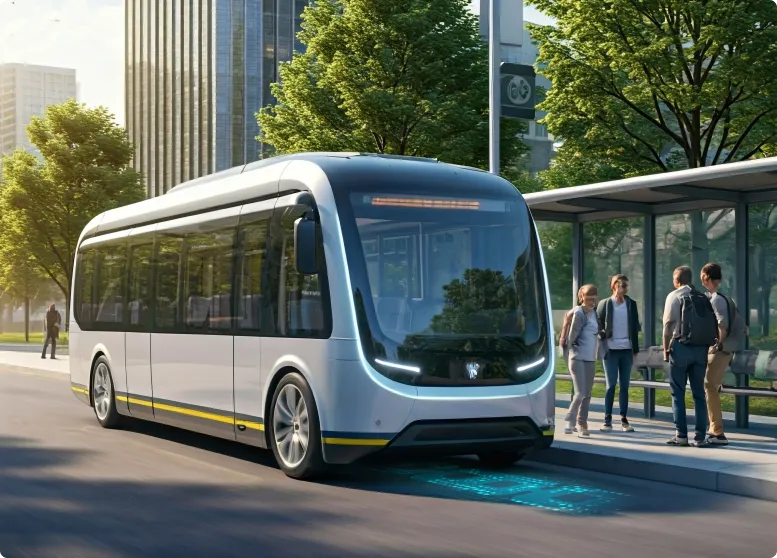
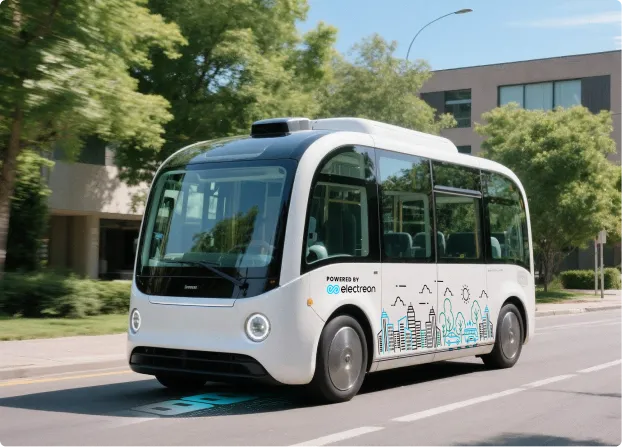
The future drives itself—charging should too. Electreon’s wireless tech keeps AVs powered effortlessly—parked, loading, or on the move. From city streets to airports to industrial facilities, self-charging AVs are the smart way forward. One platform powering today’s EVs and tomorrow’s AVs.

Hands-free power for hands-free driving

In a driverless world power takes care of itself.  Fleets keep rolling without charging waits, or off-route detours. 

Complete power solution for autonomous vehicles

Autonomous 1

Automated charging at slowdowns

Driverless vehicles self-charge while slowing down at traffic lights, passenger pickups, airport terminals, aircraft areas, industrial facilities, ports and logistics hubs.

Autonomous 3

Automated depot charging

Self-charging in any parking layout—horizontal, vertical or diagonal —without moving or plugging. Ideal for 24/7 autonomous fleets and tight, mixed lots.

Autonomous 5

Self-charging roads

Charge while driving—no stops needed—whether shuttling crews near aircraft areas, or running routes at warehouses, ports & logistics hubs.

ZERO

downtime

for 24/7 operations

Built to grow with fleets

Every new vehicle added uses the same scalable infrastructure.

Vandal-proof, clutter-free power

Out-of-sight system embedded underground, keeps sidewalks cable-free. 

Explore our AUTONOMOUS projects

Adding autonomous vehicles to your fleet? Keep them moving with seamless, hands-free wireless charging.

Frequently Asked Questions

How does wireless charging infrastructure support autonomous fleet operations?

Wireless charging infrastructure is designed to support autonomous fleet operations by providing hands-free charging, a critical requirement for true autonomy. Because charging occurs automatically, autonomous vehicles (AVs) can recharge without any human-in-the-loop intervention to connect or disconnect charging cables.

Key benefits include:

  • Hands-free charging: Vehicles are designed to charge automatically when positioned above embedded charging infrastructure.
  • No human-in-the-loop: Autonomous operations are not dependent on drivers or ground personnel to manage charging sessions.
  • Continuous fleet availability: AVs can receive opportunity charging during routine stops, reducing operational interruptions.
  • Simplified autonomous workflows: Charging is integrated into normal vehicle movements rather than requiring dedicated charging procedures.

As a result, autonomous port and logistics fleets can operate and recharge independently, enabling higher levels of automation, efficiency, and fleet utilization.

How do autonomous vehicles accurately align with the underground charging coils without a driver?

Autonomous vehicles are designed to align with underground charging coils using the Differential Inductive Positioning System (DIPS), which was adopted by SAE in 2024 as part of the SAE J2954 wireless charging standard. DIPS uses magnetic field signals from the charging infrastructure to guide vehicles to the optimal charging position without driver intervention.

Key capabilities include:

  • Standardized positioning technology: DIPS provides a globally recognized method for wireless charging alignment.
  • Precise autonomous guidance: Magnetic field data is designed to enable accurate vehicle positioning over the charging coils.
  • High misalignment tolerance: The system supports up to 20 cm lateral and 50 cm longitudinal misalignment, simplifying AV navigation and control.
  • Reliable charging performance: Vehicles can maintain efficient power transfer even when not perfectly centered.

As a result, autonomous fleets can align, charge, and operate with minimal complexity, supporting reliable hands-free charging workflows.

Is the automated charging process secure for autonomous vehicles?

Yes. Electreon’s automated charging process is designed with multiple layers of security and is supported by ISO/SAE 21434 certification, the automotive industry standard for cybersecurity engineering. To the best of Electreon’s knowledge, it is the first wireless charging provider globally to achieve this certification.

Key security features include:

  • Vehicle authentication: Energy transfer is designed to begin only after the vehicle and charging infrastructure authenticate each other.
  • RF handshake protocol: A rapid, proprietary radio frequency (RF) handshake is designed to verify the authorized vehicle in milliseconds.
  • Secure charging activation: Power is transferred only to authenticated receivers, preventing unauthorized charging events.
  • Automotive-grade cybersecurity: The system is developed and managed in accordance with ISO/SAE 21434 requirements.

As a result, autonomous vehicles can charge securely and automatically without human intervention, supporting safe and reliable fleet operations.

How does wireless charging management software optimize fleet readiness and energy use in real time?

Electreon’s charging management software is designed to prioritize vehicles based on real-time operational requirements through dynamic power allocation. The cloud-based platform is designed to support OCPP compliance and open API integration, enabling direct connectivity with fleet management systems and autonomous dispatch software.

Key capabilities include:

  • Dynamic power allocation: Charging power is designed to be distributed based on operational priorities and available energy.
  • State of Charge (SoC) optimization: Vehicles with lower battery levels can be prioritized to maintain fleet readiness.
  • Operational priority management: Mission-critical vehicles can receive charging preference to support uninterrupted logistics operations.
  • Seamless API integration: Open APIs enable real-time coordination between charging infrastructure, fleet management platforms, and autonomous vehicle systems.

As a result, ports can optimize energy use while ensuring the right vehicles are charged at the right time.

What infrastructure modifications are required to implement autonomous fleet charging?

Implementing autonomous fleet charging requires minimal infrastructure modifications. Electreon’s wireless charging system uses shallow trenching, to install passive underground coils beneath existing roadways. Roadside Management Units are then connected to manage energy transfer and system communications.

Key infrastructure benefits include:

  • Shallow trenching: Installation minimizes disruption to ongoing port and logistics operations.
  • Invisible infrastructure: Charging components are embedded below the road surface, preserving existing traffic flows and depot layouts.
  • Preserved real estate: Unlike plug-in charging stations that require a charger at each parking space, wireless charging is designed to enable higher parking density and more efficient use of depot space.
  • Scalable deployment: Additional charging segments can be integrated as autonomous fleet operations expand.

As a result, operators can support autonomous charging while maximizing valuable depot space and minimizing civil works.

Are there existing deployments or partnerships demonstrating wireless charging for autonomous vehicles?

Yes. Electreon has demonstrated wireless charging for autonomous vehicles through its partnership with ATLoS, a Portugal-based manufacturer of industrial AVs and a business unit of the ProCME Group. This first-of-its-kind deployment integrates wireless charging into autonomous logistics operations, designed to enable true set-and-forget automation without manual charging intervention.

Key highlights include:

  • ATLoS partnership: Wireless charging integrated into autonomous industrial vehicles operating on fixed logistics routes.
  • Real-world deployment: The project is deployed at a leading global production facility in Portugal.
  • Charging during operations: By embedding Electreon’s wireless charging infrastructure along the route, vehicles are designed to charge automatically at loading docks and other operational touchpoints.
  • Hands-free charging: Vehicles are designed to charge without drivers, operators, plugs, or cables.
  • Continuous operation: Seamless energy top-ups are designed to help keep AVs powered throughout the day, helping eliminate charging-related downtime.

This project demonstrates how wireless charging can serve as the enabling charging layer for fully autonomous logistics operations, allowing vehicles to complete routes and recharge without human involvement. It also opens the door to autonomous mobility applications across factories, airports, ports, food and pharmaceutical facilities, and other industrial environments.